


Biodiversity
The JAPEX Group has established policies for the conservation of biodiversity and ecosystems in the JAPEX HSE Policy and the Sustainability action plan," and is committed to biodiversity conservation in its business activities in Japan and abroad.
Basic Concept
The JAPEX Group has established a policy in the JAPEX HSE Policy to "promote the conservation of biodiversity and other resources." In addition, we have set "biodiversity and ecosystem conservation" as one of our challenges in our Sustainability action plan." Based on these policies, we have formulated and implemented business plans for both domestic and overseas projects and individual projects, based on the premise of conserving biodiversity from the time the project is formulated to the end of the project.
When formulating new business plans, in addition to legally mandated environmental impact surveys, we conduct voluntary environmental impact assessments according to the conditions of rare species and ecosystems in the surrounding area. In existing projects, we are also working to reduce the negative impact of our business activities through regular review of risks and measures as well as ongoing monitoring.
TNFD Report
In fiscal 2026, the JAPEX Group published its first standalone "TNFD Report." The Taskforce on Nature-related Financial Disclosures (TNFD) recommendations encourage disclosing information based on four pillars: Governance, Strategy, Risk and Impact Management, and Metrics and Targets. Based on these recommendations, we conducted an analysis using nature-related scenarios and examined our disclosure content while referring to TNFD's " Additional sector guidance ‒ Oil and gas" Specifically, focusing on the oil and natural gas exploration, development, and production (E&P) sector--the core business of the JAPEX Group--and its value chain, we analyzed the relationship between our business and nature (dependencies and impacts) as well as the risks. Furthermore, by conducting a scenario analysis with reference to this guidance, we identified risks under "Strategy" and formulated core metrics under "Metrics and Targets," thereby deepening our conventional disclosure content.
Evaluation of Dependencies and Impacts on Nature
In September 2023, the TNFD(*1) recommendations, calling for information disclosure on natural capital and biodiversity, were released. JAPEX evaluated the dependencies and impacts of its businesses on nature and identified priority business areas for the first-stage consideration of the LEAP analysis(*2), endorsed in the Recommendations. The results were reported to the Sustainability Committee.
Recognizing the importance of assessing the relationship between our operations and the natural environment from the perspectives of "dependency" and "impact," we analyzed the level of dependency and impact on nature for each key business process*3. Dependency on nature and the levels of impact for each factor are classified into five levels, ranging from "Very High (VH)" to "Very Low (VL)." Through this evaluation, we found that water resources, other resources, and climate regulation had significantly high levels of dependency on nature, while GHG emissions and water use had high levels of impact on nature.
Note:
*1:The Taskforce on Nature-related Financial Disclosures (TNFD) is an international organization established to develop frameworks that help companies and financial institutions properly assess and disclose risks and opportunities related to natural capital and biodiversity.
*2:A comprehensive evaluation process for managing nature-related risks and opportunities, focusing on the biomes and regions where a business operates. "LEAP" refers to the four phases of "Locate," "Evaluate," "Assess," and "Prepare."
- Related
Qualitative Evaluation of Risks and Opportunities Related to Nature
We analyzed risks and opportunities related to nature expected at this point to clarify their relationship. Additionally, we collected information on external cases in each area where we depend on and impact nature. Major nature-related risks for JAPEX's businesses are categorized into physical and transition risks. Physical risks include operational disruptions due to water shortages and the impact of increased extreme weather on land and sea facilities. Transition risks include additional costs due to environmental laws and regulations, including carbon taxes, and claims for damages from accidental crude oil spills.
Identification of Priority Field
Based on the "evaluation of dependencies and impacts on nature" and "qualitative evaluation of risks and opportunities to nature," the E&P field was identified as having the highest dependency, impact, and risks among all of JAPEX's businesses. Therefore, it is designated as the top priority field for the LEAP analysis. Starting in fiscal 2024, we are prioritizing the LEAP analysis for the E&P field. At our direct operation bases, we are evaluating nature-related risks and opportunities for our business activities, focusing on priority regions. Additionally, we will consider encompassing important risks and opportunities into our strategy based on the results of the LEAP analysis for the priority field.
- Related
Measures at Domestic Offices
In Japan, JAPEX formulates and implements business plans based on the assumption that we preserve the organisms that live in the vicinity of sites where environmental impact surveys are conducted and that are designated as species to be protected in the Red List and other lists.
After the completion of the construction of project facilities and after the completion of projects, we carry out restoration work in consideration of the maintenance and recovery of the local ecosystem.
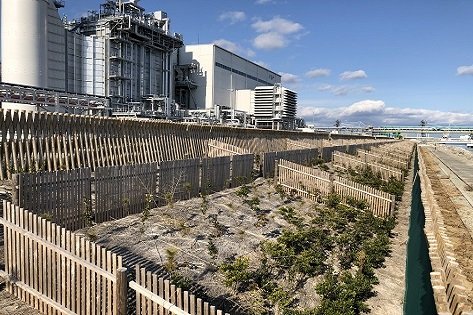 2019
2019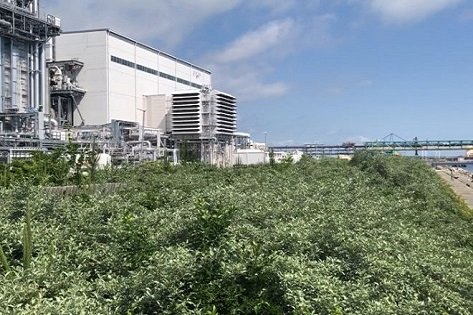 Present
Planting trees of native species at the Fukushima Natural Gas Power Plant
(Fukushima Gas Power Co., Ltd.)

Our website uses cookies to improve the convenience of our visitors when browsing our site. If you agree with our policy on the use of cookies, please click the "Agree" button. If you do not agree to the use of cookies when browsing our website, please disable the cookie setting in your browser.